Shredding old paperwork can be a daunting task for businesses and homes alike. Whether you have been storing your obsolete personal documents in the garage for years or have boxes full of private work documents strewn around the office, gathering and disposing of old files can be a chore. Additionally, it can be difficult to decide what can be shredded.
At Shred Nations, our mission is to provide you with the answers and tools you need to make smart decisions about your document shredding needs. This article will answer the most common questions we receive about shredding.
What Can Be Shredded?
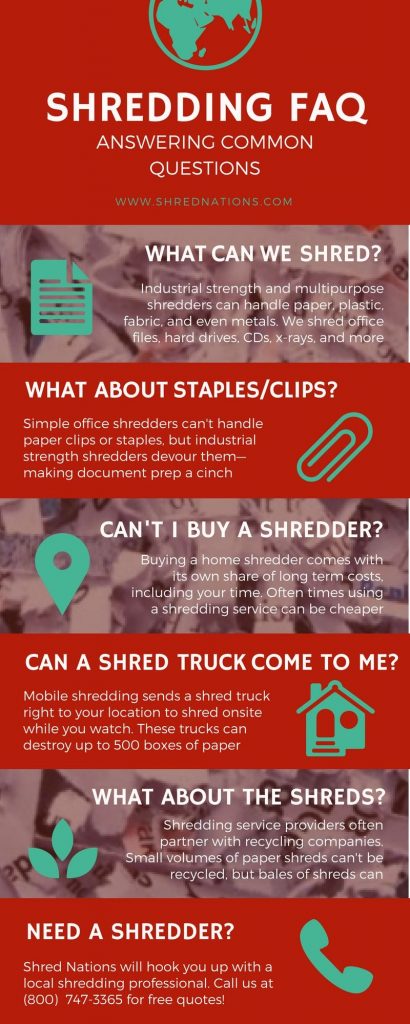
The better question might be: what don’t we shred? Although shredding companies generally focus on shredding paper, they are more than capable of shredding plastic, fabric, and even metals.
Industrial shredders can shred all of these materials:
Paper
Plastic
Fabric
Metals
Magnetic media
CDs and DVDs
Hard drives
X-rays
Microfilm
ID badges
And more
Materials only need to be shredded if they contain sensitive information, but many people forget about sensitive information stored magnetically or electronically.
Fax machines and scanners store copies of the items sent through them, and anything with a name, date of birth, or any piece of personal information needs to be thoroughly destroyed to avoid the potential for identity theft.
Can Staples and Paperclips Be Shredded?
Now that you know what you can shred, you might be wondering how to prep your materials for shredding. Fortunately, since industrial shredders can shred all types of materials, you don’t need to sort or organize your documents at all before destruction. You don’t have to remove staples, paper clips, binder clips, or folders. Just toss your documents as they are into a secure shred bin until they are ready for shredding.
What exactly is a shred bin? A shred bin is a lockable bin where you can store your documents until you are ready to shred them. If you sign up for regular shredding services, you can store these secure bins throughout your office to gather papers until the next scheduled shredding date.
Which Shredding Service Best Meets My Needs?
There are three main document shredding service options:
Mobile shredding is the most convenient shredding service available. All you need to do is gather the papers you need shredded, and the shredding company takes care of the rest.
A shred truck comes to your location, the shredding professional feeds your files through the shredder at the end of the truck, and the shreds are driven to a secure facility to be baled and recycled. The average price for this service is around $150-$200 for projects of 1-10 boxes. However, the cost will vary on your location, the size of your project, and more.
The only difference between mobile and off-site shredding is that the off-site option shreds your files off-site at a secure facility. With this service, your files are picked up from your location, but you don’t get to watch as the shredding is done. Instead, your files are taken to a secure facility housing a large industrial shredder where your papers are mingled with thousands of other documents and quickly shredded.
The average price for this service is around $120-$150 for a project between 1-10 boxes. The price will also vary on your location, size, and other factors.
This service option meets the needs of low-volume shredding projects. If you have 90 lbs or less, having a shredder come to you is not cost-efficient. But drop-off shredding locations are all over the US—find one near you with this location tool. The average price for this service is around $1.
Can I Just Buy A Personal Shredder Instead?
Personal shredders retail for anywhere from $15 to $200+ and they can be an enticing option for individuals and small businesses with just a few pounds of paper to shred a month. Unfortunately, cheap shredders break easily and have short life spans.
If you are willing to spend upwards of several hundred dollars and perform regular maintenance on your shredder, you’ll be more likely to own a shredder that can handle your needs for about 10 years. But beware of the downsides of owning your shredder. For example, HIPAA requires that information be unreadable to comply with its regulations. Moreover, some personal shredders don’t shred papers small enough.
More reasons personal shredders are inefficient:
They jam frequently and easily
They don’t accept paper clips/staples
They quickly overheat
They are slow and only handle 1-10 sheets of paper at a time
They are loud
They have short life spans, only lasting 5 years on average
They are messy and require clean-up
You have to perform maintenance regularly
Depending on the volume of paper you have to shred, and the amount of time you are willing to spend shredding your files, a personal shredder might work for you. But remember to consider the long-term costs associated with owning a home shredder.
What Happens to the Shreds?
When you shred paper in a small personal shredder, you’ll end up with a couple of pounds of shredded paper that most recycling services won’t accept.
Fortunately, when you go through a shredding company, they produce enough shredded paper that they can bale it and send it off to recyclers to have the paper bits reused.
When you use a shredding service provider, they will recycle your shreds. This is not only good for the environment but adds another layer of security for your shredded materials.
Ready To Shred Your Files?
Shred Nations partners with document shredding service providers across the US. We can connect you to shredding professionals in your area who can meet your needs. For free quotes on shredding services near you, call us at (800) 747-3365 or fill out the form.
This website utilizes technologies such as cookies to enable essential site functionality, as well as for site improvement analytics and personalized services. We also share user traffic data with our analytics and search engine paid advertising platforms for improving performance of these campaigns. Personal information such as name, phone, email address and zip code is used by us and our servicing partners to contact you and service your request. By continuing to use this website, clicking OK, or by closing this notice using the 'X', you consent to the use of cookies. Not consenting or withdrawing consent, may adversely affect certain features and functions. To manage your preferences, please click on the Opt-Out Personal Information and Cookie Preferences link. You may also exercise your Do Not Sell My Personal Information option by clicking on the Opt-Out Personal Information and Cookie Preferences link.
Functional
Always active
The technical storage or access is strictly necessary for the legitimate purpose of enabling the use of a specific service explicitly requested by the subscriber or user, or for the sole purpose of carrying out the transmission of a communication over an electronic communications network.
Preferences
The technical storage or access is necessary for the legitimate purpose of storing preferences that are not requested by the subscriber or user.
Statistics
The technical storage or access that is used exclusively for statistical purposes.The technical storage or access that is used exclusively for anonymous statistical purposes. Without a subpoena, voluntary compliance on the part of your Internet Service Provider, or additional records from a third party, information stored or retrieved for this purpose alone cannot usually be used to identify you.
Marketing
The technical storage or access is required to create user profiles to send advertising, or to track the user on a website or across several websites for similar marketing purposes.
To provide the best experiences, we use technologies like cookies to store and/or access device information. Consenting to these technologies will allow us to process data such as browsing behavior or unique IDs on this site. Not consenting or withdrawing consent, may adversely affect certain features and functions.
Functional
Always active
The technical storage or access is strictly necessary for the legitimate purpose of enabling the use of a specific service explicitly requested by the subscriber or user, or for the sole purpose of carrying out the transmission of a communication over an electronic communications network.
Preferences
The technical storage or access is necessary for the legitimate purpose of storing preferences that are not requested by the subscriber or user.
Statistics
The technical storage or access that is used exclusively for statistical purposes.The technical storage or access that is used exclusively for anonymous statistical purposes. Without a subpoena, voluntary compliance on the part of your Internet Service Provider, or additional records from a third party, information stored or retrieved for this purpose alone cannot usually be used to identify you.
Marketing
The technical storage or access is required to create user profiles to send advertising, or to track the user on a website or across several websites for similar marketing purposes.